


The Government of India will invest Rs 4,500 crore to modernize the Semiconductor Laboratory (SCL) in Mohali, Union Electronics and IT Minister Ashwini Vaishnaw announced during his visit to the facility on November 28, 2025. He also assured that SCL will not be privatized and will continue to play a central role in India’s semiconductor mission.
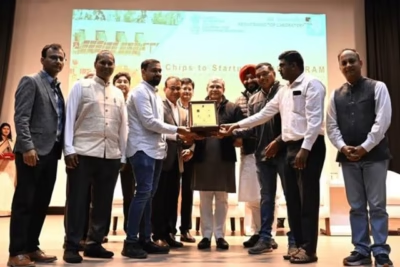
The Minister, along with MoS IT Ravneet Singh, reviewed the ongoing upgrade work at SCL and took part in an event where 28 student-designed semiconductor chips from 17 academic institutions were handed over. With this batch, SCL has fabricated a total of 56 chips under the Chips to Start-up (C2S) program.
The chips were designed using top-notch Electronic Design Automation (EDA) tools provided to students through government support. The Minister pointed out that almost 300 universities in India now have access to these tools, creating a unique ecosystem globally.
Modernization Roadmap
Union Electronics and IT Minister Ashwini Vaishnaw outlined a comprehensive plan for SCL’s transformation. The government will invest ₹4,500 crore to upgrade the facility with modern features and significantly boost its production capabilities—targeting a 100-fold increase in current wafer output. SCL will continue to support students, researchers, and start-ups by providing fabrication services. To enable this expansion, the Centre has also requested the Punjab government to allocate 25 acres of land for future development.
New Facilities Inaugurated
The Minister inaugurated two key additions to strengthen SCL’s technical and training ecosystem: the Semiconductor Process Gallery, which demonstrates fabrication tools and clean-room technologies for student learning, and the Abhyuthanam Training Block, offering hands-on training modules, semiconductor coursework, and fire-safety training.
Strategic Self-Reliance Push
He further emphasized that India is pursuing self-reliance in strategic sectors, including chip manufacturing. A consortium of CDAC, DRDO, and other institutions will collaborate on indigenous chip design, development, and manufacturing.
(This content is sourced from a syndicated feed. The Japan India Manufacturing Journal website assumes no responsibility or liability for its accuracy, completeness, or content.)


COMMENTS